How To Pick Trekking Poles For Hiking: Length, Material, And Type Explained
Author:sana
|
Released:January 31, 2026
If you hike flat paths with a light pack, a single staff may be enough. If your routes include climbs, descents, loose ground, or a heavier load, a pair of trekking poles usually makes more sense.
The right choice is not about buying the most expensive gear. It is about matching the tool to your trail, your body, and how much you want to carry.
Start With Your Trail
The first question is simple: Where do you usually hike?
If you mostly walk on flat or gently rolling trails, a hiking staff can be a good fit. It gives you one point of support and keeps the setup simple. It works well when you want a little balance help, but not a full pair of poles.
If your hikes include hills, uneven ground, or long descents, trekking poles are usually the better choice. Two poles give you more stability and spread the work across both arms. That can make long days feel less tiring.
If you travel often, packing size matters too. A folding pole is much easier to store in a backpack or suitcase than a long fixed pole. If budget matters most, aluminum is usually the most practical starting point.
Single Staff Or Two Poles
A hiking staff is one pole. It is simple, direct, and easy to use. It also keeps one hand free, which some hikers prefer on easier trails or casual walks.
A pair of trekking poles gives you support on both sides. That helps on steep climbs, tricky descents, and rocky or loose terrain. If you carry a pack, the extra support becomes even more useful.
Here is the cleanest way to think about it:
- Single staff= simpler, lighter feeling, one-hand support.
- Two poles= steadier, more balanced, better for changing terrain.
If you are unsure, ask yourself which matters more: simplicity or support.
The Three Main Pole Types
- Fixed-length poles
These have one set length. They are simple and often lighter. The downside is obvious: if the length does not fit you well, there is no room to adjust.
Fixed poles work best if you already know your preferred size and hike on similar terrain most of the time.
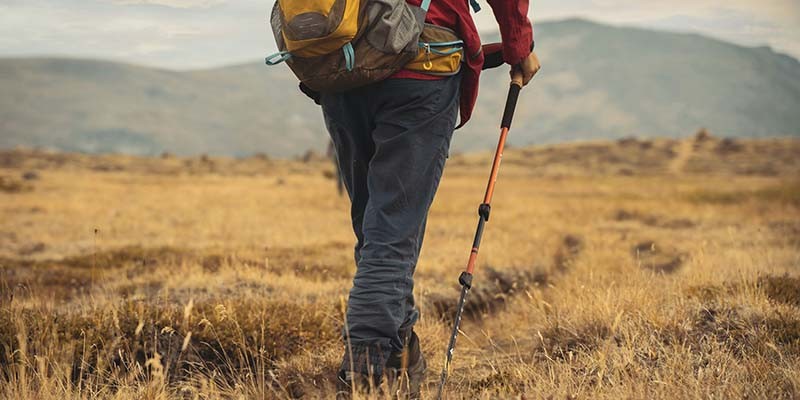
- Adjustable poles
These are the most flexible. You can shorten them on climbs and lengthen them on descents. They are the best all-around choice for most hikers.
If your route changes a lot, or if you want one pole to handle different conditions, adjustable is usually the safest bet.
- Folding poles
These collapse into a smaller shape. They are easier to pack and store, which makes them attractive for travel or light, compact gear setups.
If you want a pole that fits neatly in a daypack or carry-on bag, folding poles are worth a close look.
How Long Should Trekking Poles Be?
Length is one of the most important parts of the decision. A pole that is too short feels cramped. A pole that is too long feels awkward and can throw off your posture.
A good starting point is the 90-degree elbow rule:
- Stand upright.
- Hold the pole with the tip on the ground.
- Your elbow should bend at about 90 degrees.
That gives you a practical baseline.
A rough height guide looks like this:
- Under 5'1" / 155 cm → about 100 cm
- 5'1"–5'7" / 155–170 cm → about 110 cm
- 5'8"–5'11" / 173–180 cm → about 120 cm
- 6'0"+ / 183 cm and above → about 130 cm
This is a starting point, not a rule carved in stone. Arm length, pack weight, and terrain can all change the best fit.
Here is a more concrete example.
If you are around 5'10" / 178 cm, a pole around 120 cm is often a good starting point.On a steep climb, you might shorten it to 110–115 cm.On a long descent, you might lengthen it to 125–130 cm.
If you are around 5'4" / 163 cm, a pole around 110–115 cm is usually closer to the mark.If you are around 6'1" / 185 cm, a 130 cm pole is often the better place to begin.
The big idea is this: you do not need one perfect number. You need a pole that gives you room to adjust.
Why Adjustability Matters
If you hike only on flat ground, one fixed length may work fine. But most trails are not that neat. They change.
That is why adjustable poles are so useful. On uphill sections, shorter poles keep your arms in a more natural position. On downhill sections, longer poles help with balance and reduce the feeling that you are reaching too far.
A good adjustment range matters too. If you are taller than about 6 feet / 183 cm, make sure the pole extends far enough. REI’s guide, for example, notes that taller hikers should look for a maximum length of at least 51 inches. That gives you more room to work with on real trails

Aluminum Or Carbon Fiber?
Material affects three things at once: weight, durability, and price.
Aluminum
Aluminum is the practical choice for many hikers. It is durable, widely available, and usually cheaper than carbon fiber. If you are new to poles, or you expect rough use, aluminum is a smart choice.
It may not be the lightest option, but it often gives the best value.
Carbon fiber
Carbon fiber is lighter. That makes it attractive for long hikes, fast movement, or trips where every ounce matters. It can reduce swing weight and make the poles feel easier to carry over time.
The tradeoff is cost. Carbon fiber usually costs more, and it is not always the best choice if you are hard on gear or want the best value per dollar.
A simple rule works well here:
- Budget and durability → aluminum.
- Lower weight and higher price → carbon fiber.
How Much Should You Pay?
It helps to think in price bands instead of chasing a single “best deal.”
Budget range: $25–$50
This is where many basic aluminum poles live. They can work well for casual hikers, short trips, or first-time buyers. If you only hike occasionally, this range is often enough.
Midrange: $50–$100
This is the sweet spot for many people. You often get better locks, better grips, lighter build quality, and more reliable folding or adjustable designs. If you hike regularly, this range often gives the best balance of comfort and price.
Premium range: $100 and up
This is where lighter carbon fiber models and more refined builds usually appear. These are best for hikers who care about weight, travel a lot, or spend a lot of time on trail.
A good shortcut is:
- Occasional use → budget range.
- Regular hiking → midrange.
- Weight-sensitive or frequent use → premium.
Grip Materials And Comfort
The grip changes how the pole feels in your hand after an hour or two. That matters more than many first-time buyers expect.
Cork
Cork grips are comfortable and handle sweat well. They are a very good choice for long hikes.
Foam
Foam grips are soft and light. They often feel good in warm weather and on longer outings.
Rubber
Rubber grips offer a firmer feel and can be useful in cold or wet conditions. They are often the best pick if you hike in rough weather.
If your hands sweat a lot, cork or foam may feel better. If you hike in rain, snow, or cold wind, rubber may be more useful.
Useful Features, Not Extra Clutter
Not every feature is worth paying for.
Shock absorption
Some poles include shock-absorbing parts. These can soften impact, especially on descents. Some hikers like that. Others do not care much. It is useful, but not essential.
Locking system
This is more important than it sounds. If the pole slips, the whole experience gets annoying fast. A secure lock is worth more than a fancy spec sheet.
Tips, baskets, and add-ons
These matter if you hike in snow, mud, or soft ground. If you mostly hike on normal trails, they are less important.
Camera Or Accessory Mounts
Nice to have, but only if you will actually use them.
The rule is simple: buy features that solve a real problem, not ones that just look impressive.
How To Choose In Practice
If you want the shortest answer possible, use this:
- Flat trails + light pack → single hiking staff.
- Steeper trails + uneven ground + heavier pack → trekking poles.
- Travel and packing space matter → folding poles.
- Budget matters most → aluminum.
- Lower weight matters most → carbon fiber.
- Mixed terrain → adjustable poles.
That one list will eliminate most bad choices quickly.
Closing Note
The best trekking pole is not the fanciest one. It is the one that fits your usual hike, your body, and your budget.
Start with your trail. Then choose the type, length, material, and grip that match it. That keeps the decision practical and makes it much easier to buy gear you will actually use.
Related Posts
Outdoor Gear
How to Choose the Best Camping Stove for Backpacking
Outdoor Gear
Gaiters For Hiking: When You Actually Need Them and How to Choose
Activities
How To Safely Cross Rivers While Hiking With 9 Simple Safety Checks
Destinations
Top Volcano Hikes in Indonesia and the Philippines You Should Explore

Activities
How To Protect Yourself From Insects On Trails And Avoid Painful Bites

Guides and Tips